It is the first question almost every homeowner in Ahmedabad asks us: should we choose Italian marble or Indian marble? The honest answer is that neither is “better”. They are different materials with different strengths, and the best homes often use both. This guide explains the differences so you can decide room by room.
The basics: what each term means
Italian marble is a broad trade term for marbles imported from Italy — and, in everyday Indian usage, often from Turkey, Greece, Spain and other countries too. Famous Italian varieties include Statuario, Carrara and Botticino. They are usually supplied as large slabs that are cut to size for each project.
Indian marble is quarried in India, mainly in Rajasthan (Makrana, Rajsamand, Kishangarh, Udaipur region) and Gujarat (Ambaji). Makrana white is the most celebrated, used in monuments for centuries. Indian marble is available in slabs and in standard tile sizes.
Rule of thumb: Italian marble for the rooms you want guests to remember; Indian marble for the rooms you want to stop worrying about.
Look and character
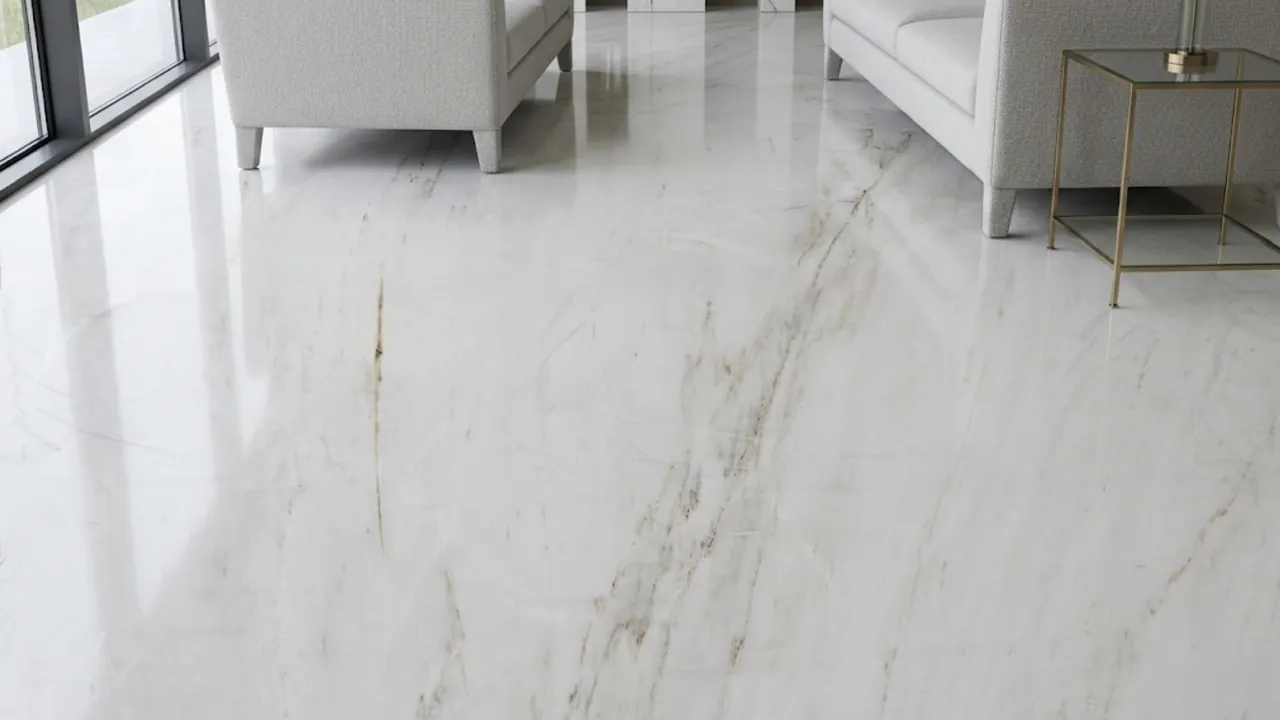
Italian marbles are prized for their colour, translucency and the depth of their polish. Whites can be strikingly bright with bold or feathery veins; coloured marbles such as greens, reds and browns are dramatic statement stones. Because slabs are large, a floor can be laid with matched veining that flows from one slab to the next, and walls can be book-matched.
Indian marbles tend to have a finer, more uniform grain. Makrana white, in particular, has a soft, even white that glows rather than shouts. Many Rajasthan marbles come in greens, pinks, greys and beiges with subtler patterns. The look is classic and calm, especially across large areas.
Durability and hardness
All marble is a calcium-carbonate stone, softer than granite or quartzite, and all marble can etch when it meets acids. Within that family, many Indian marbles — Makrana white included — are dense, low-porosity stones that cope very well with foot traffic and stay bright for decades. Some imported marbles are softer and more porous, and a few varieties are reinforced with resin and mesh on the back during processing because of natural fissures. That is normal practice and not a defect, but it means the stone needs a little more care.
The practical takeaway: for heavy-traffic areas and large floors, a dense Indian marble is very hard to beat. For feature walls, living rooms and bathrooms, the extra care an Italian marble needs is usually worth it.
Maintenance
- Sealing: seal any marble after installation, and re-seal every one to two years in kitchens and bathrooms.
- Cleaning: use pH-neutral stone cleaners. Avoid acids (lemon, vinegar), bleach and abrasive powders.
- Spills: wipe quickly. A polished surface shows etching more than a honed one.
- Renewal: both Italian and Indian marble can be honed and re-polished on site, so a tired floor can be brought back rather than replaced.
If you want a marble look in a hard-working kitchen, consider a natural quartzite such as Taj Mahal, which resists etching far better.
Budget
Indian marble is generally more economical, especially for large areas, and is easier to buy in consistent quantities. Italian marble prices vary hugely: some imported varieties are comparable to good Indian marble, while premium Statuario or rare coloured marbles sit at the top of the market. Remember that the stone itself is only part of the cost. Slab wastage when cutting, book-matching, edge work, laying and final polishing all add up, and large-format Italian slabs often need more careful handling and installation.
| Factor | Italian marble | Indian marble |
|---|---|---|
| Look | Bright, dramatic or rare colours; deep polish | Even, classic; very bright whites (Makrana) |
| Format | Large slabs, book-matching possible | Slabs and standard tiles |
| Durability | Varies by variety; often softer | Many dense, hard-wearing varieties |
| Care | Seal, gentle cleaning, avoid acids | Seal, gentle cleaning, avoid acids |
| Budget | Mid to very high | Economical to mid; premium Makrana grades higher |
| Best for | Living areas, feature walls, baths | Large floors, stairs, puja rooms, terraces |
Where to use each in your home
Living and dining rooms
These are the rooms where Italian marble shines. A large-format floor with veining matched across the slabs, or a book-matched wall behind the sofa, sets the tone for the whole house.
Bedrooms and corridors
Indian marble is a practical choice here: comfortable underfoot, easy to maintain and consistent over long runs. Many clients carry a coordinated Indian white through bedrooms and passages.
Bathrooms
Either works. Honed finishes improve grip and hide water marks. Italian marble makes a beautiful vanity and shower wall; Indian marble is excellent for floors.
Puja room
Traditional Makrana white remains the favourite for floors, mandirs and carving.
Kitchen
Marble floors are fine; for the countertop most families prefer granite or quartzite.
Ahmedabad’s climate and lifestyle
Marble stays pleasantly cool underfoot in Ahmedabad’s long summers, which is one reason it is so popular here. Dust is the main enemy of a polished floor: fine grit acts like sandpaper. Doormats at entrances, regular dry mopping and felt pads on furniture make more difference than the choice between Italian and Indian marble.
A simple buying checklist
- Decide the role of each room — statement or everyday.
- See full slabs in daylight, not just small samples.
- Ask about density, any resin reinforcement and recommended finishes.
- Buy all the stone for a space from one lot, plus 10–15% extra for cutting and matching.
- Agree the layout and vein direction before cutting starts.
- Plan sealing and a gentle cleaning routine from day one.
Want to compare both side by side? Visit our Display Center in Shela — we keep Italian and Indian marbles together so you can see the difference in person.
Quick answers
Is Italian marble better than Indian marble?
Neither is universally better. Italian marble is chosen for its look and polish; many Indian marbles are denser, more economical and ideal for large floors.
Which marble is best for an Ahmedabad home?
Many homes combine both: Italian marble in living areas and feature walls, Indian marble in bedrooms, corridors and stairs.
Does Indian marble turn yellow?
Good-quality, well-maintained Indian marble stays bright. Yellowing is usually caused by poor-quality stone, unsuitable sealers or harsh cleaning chemicals.